In the lubricant industry, the separation of production and branding is no longer a new concept. More and more brand owners are choosing an asset-light approach—outsourcing manufacturing, quality control, certifications, and even formulation development to specialized contract manufacturers. Yet few manufacturers can truly carry that level of trust, especially when brand owners want the quality and certifications of a large factory combined with the flexibility and responsiveness of a smaller one.
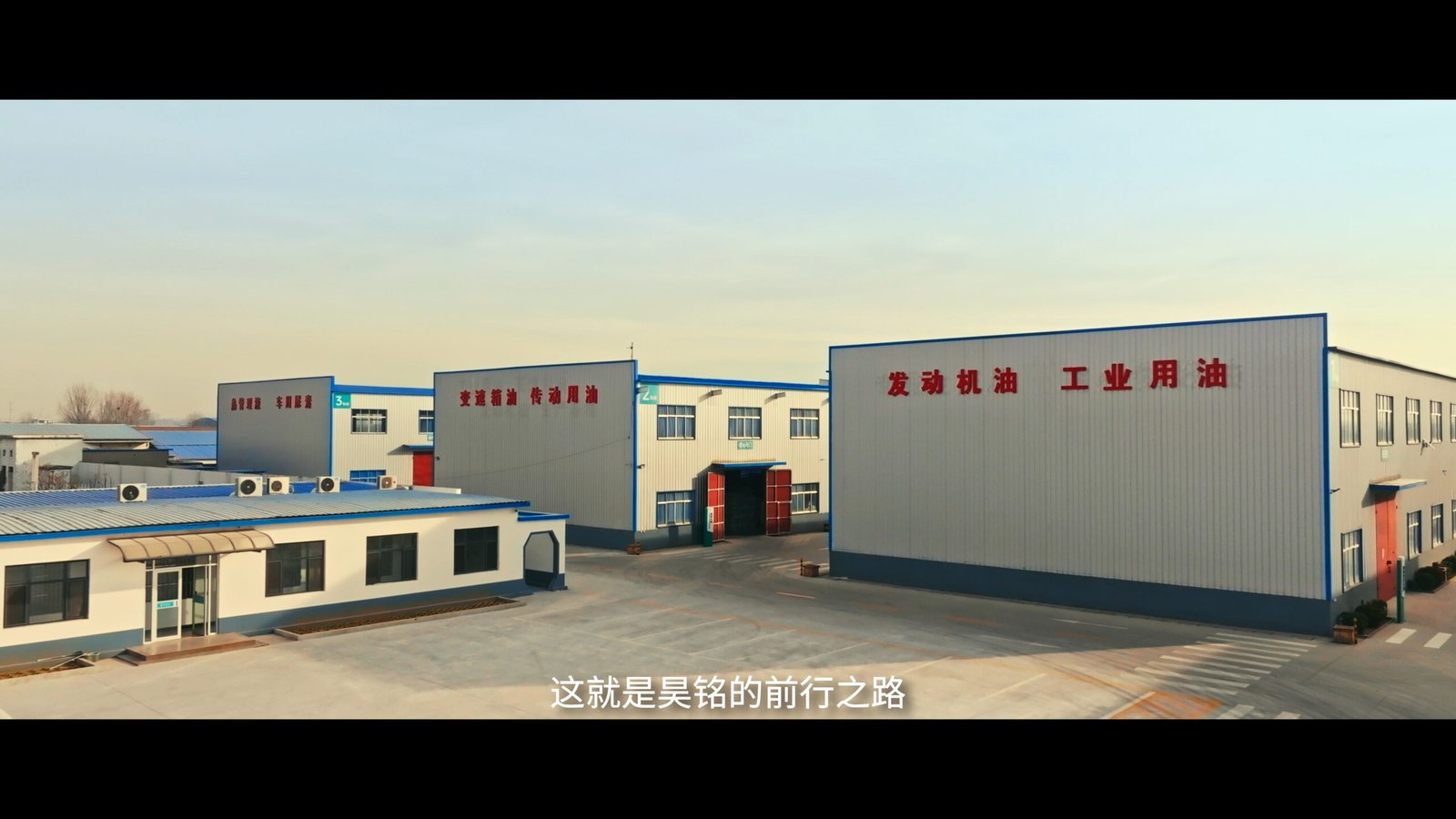
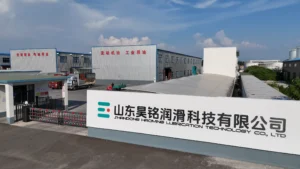
In Dongying, Shandong—home to China’s second-largest oilfield, Shengli Oilfield—there is a lubricant OEM manufacturer that has completed its transformation over more than a decade: Shandong HAOMING Lubrication Technology Co., Ltd. From its establishment in 2012 to a facility spanning over 40,000 square meters, with annual capacity of 70,000–80,000 tons and the ability to flexibly switch between 585 oil products, HAOMING has carved out a distinctive path: no private-label brand of its own, only serving as a trusted manufacturing partner behind brand owners. In 2026, HAOMING also participated as a drafting unit in two group standards for new energy vehicle fluids, placing it at the forefront of the EV fluid segment.
From Selling Its Own Oil to Helping Others Build Better Oil
HAOMING’s turning point came around 2018. At that time, the company already had stable production capacity and a base of its own channel customers. But founder Zhao Yunshan noticed a clear trend: more and more regional brands and auto parts chains were no longer building their own plants—they were looking for reliable contract manufacturers. At the same time, certification thresholds in the lubricant industry were rising. API, ACEA, and OEM standards were constantly upgrading, and small and medium-sized brands simply could not afford the millions of RMB required for certification and equipment.
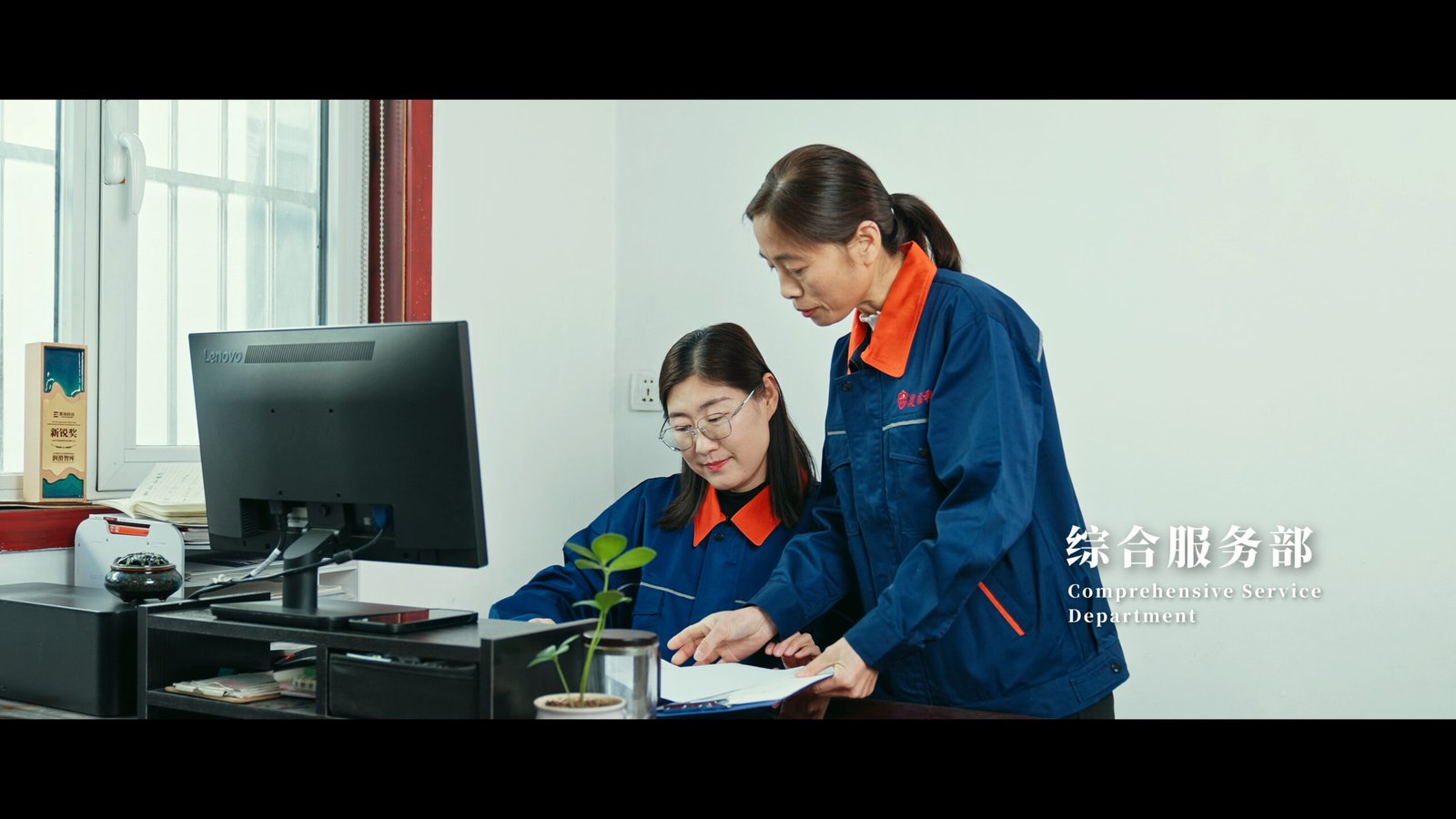
“Rather than competing with our own OEM customers in the end market, we should completely transform and open up all our capabilities.” HAOMING made what seemed like a bold decision at the time: actively shrink its own brand business and shift fully to OEM/ODM manufacturing. To support this, the company rebuilt its organizational structure, established a full-process customer service department, and adopted the service principle of “connecting with every partner through heart.”
The transition was not easy. But looking back, this strategic repositioning allowed HAOMING to avoid the awkward “both player and referee” situation many contract manufacturers face. It also earned the long-term trust of multiple leading auto parts chains in China, dozens of lubricant brands, and overseas customers in more than a dozen countries.
The “Flexible Manufacturing” Foundation Behind 585 Oil Product Switchovers
What do OEM customers fear most? High minimum order quantities, slow changeovers, and chaotic multi-SKU management. A startup brand wants to test the market with two transmission fluid products. Many factories simply wave them off: “Minimum 10 tons.” HAOMING’s answer: “1-ton minimum, fast delivery.”
This “small-batch, fast-response” capability comes from years of continuous upgrades to HAOMING’s production system. The company operates three core workshops—engine lubricant, drivetrain lubricant, and professional water-based products—equipped with 22 blending tanks ranging from 1 ton to 35 tons. More importantly, HAOMING has introduced the VPG intelligent pigging system, manifold system, and DDU automatic extraction system, achieving precise control and zero-residue pipeline cleaning from base oil feeding to filling. This means the previous batch could be 0W-20 full synthetic engine oil, and the next batch can switch to 75W-90 gear oil without stopping to clean the pipeline or risking cross-contamination.
The system supports flexible switching and filling for 585 oil products. Combined with fully automatic filling lines and ABB palletizing robots, annual filling capacity reaches 70,000–80,000 tons, with monthly delivery capacity exceeding 6,000 tons.
Dual-Certified Laboratory: Every Batch Stands Up to Scrutiny
Inside HAOMING’s facility is a high-standard quality inspection center built with an investment of RMB 10 million. It is not just for show—it holds both CNAS national accreditation and CMA metrology certification, a rare “dual-certified” laboratory among lubricant contract manufacturers in China.
CNAS accreditation means HAOMING’s test reports are mutually recognized in many countries worldwide and can be used directly for export business. CMA certification means the reports carry legal validity and can serve as a basis for quality arbitration, government procurement, and trade transactions. The laboratory is equipped with more than 40 advanced instruments, including automatic kinematic viscosity testers, four-ball friction testers, and high-temperature high-shear testers. It can test over 30 key indicators such as kinematic viscosity, low-temperature dynamic viscosity, HTHS, four-ball test, and KRL shear stability. The company also has more than 50 sets of experimental and testing equipment, a core R&D team of five including graduates from 985 universities and postgraduate degree holders, and 17 mid-level or above professional technicians. The laboratory has been recognized as a municipal key laboratory for high-performance lubricating grease in Dongying.
One customer commented: “Working with HAOMING is like having our own national-level laboratory.” This trust endorsement often plays a decisive role in government bus company tenders or overseas importer factory audits.
Technical Investment and Certification System: Internationally Advanced Patents and Full-Grade Approvals
HAOMING continues to increase its technical investment. The company has been recognized as a National High-Tech Enterprise, a Shandong “Specialized, Refined, Distinctive, and Innovative” SME, and a Shandong “One Enterprise, One Technology” R&D Center. To date, the company owns 37 patents (including invention, utility model, and design patents), 32 trademarks, and 16 enterprise standards.
In terms of technical support, HAOMING works closely with Afton, one of the world’s four largest additive giants, and Mobil, a leader in synthetic base oils, obtaining direct technical support and priority raw material supply. One of its invention patents, “A Gasoline Engine Lubricant with Good Anti-Wear Performance and Its Preparation Method” (Patent No. ZL201510677604.4), was evaluated by an expert panel as reaching internationally advanced levels.
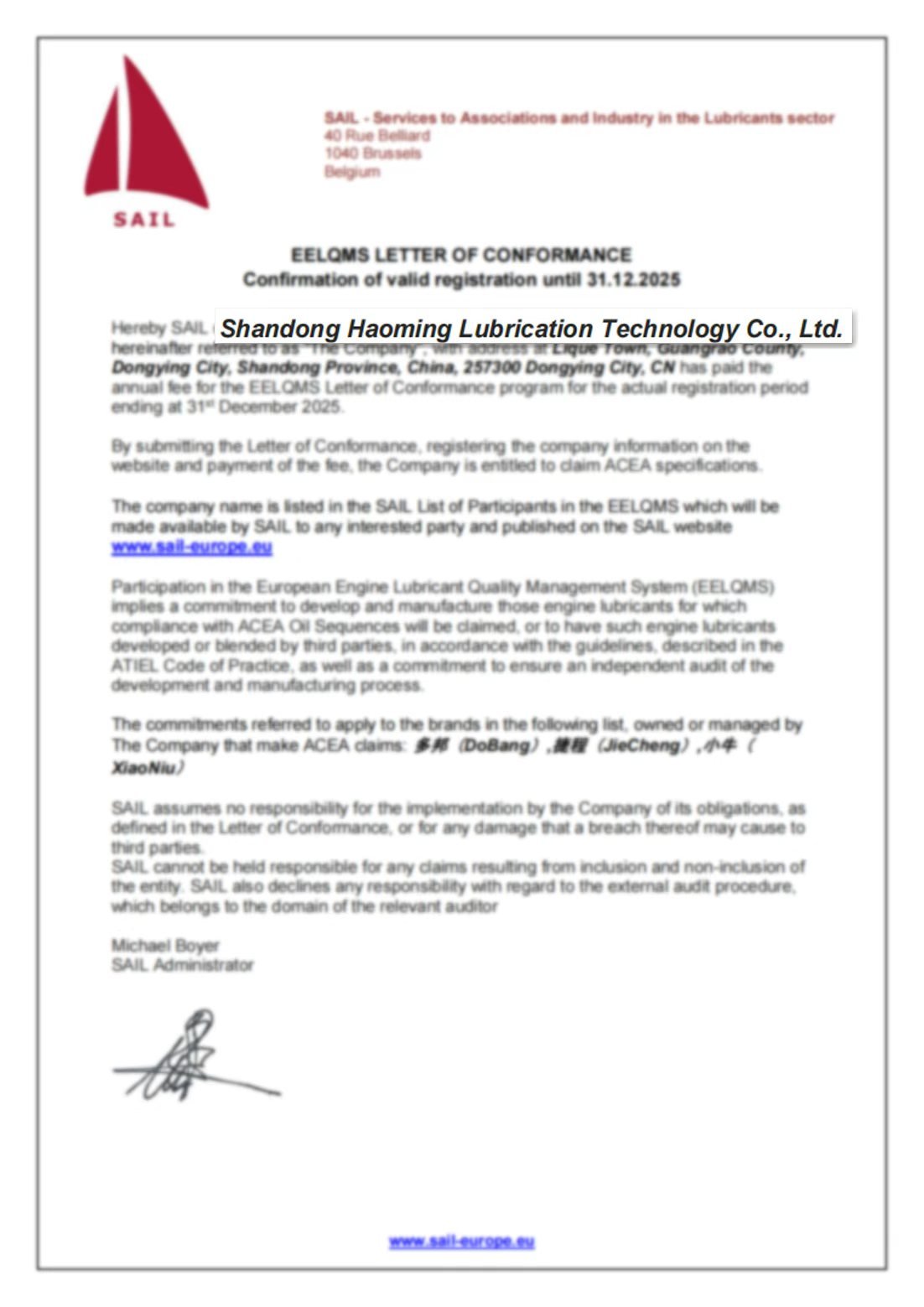
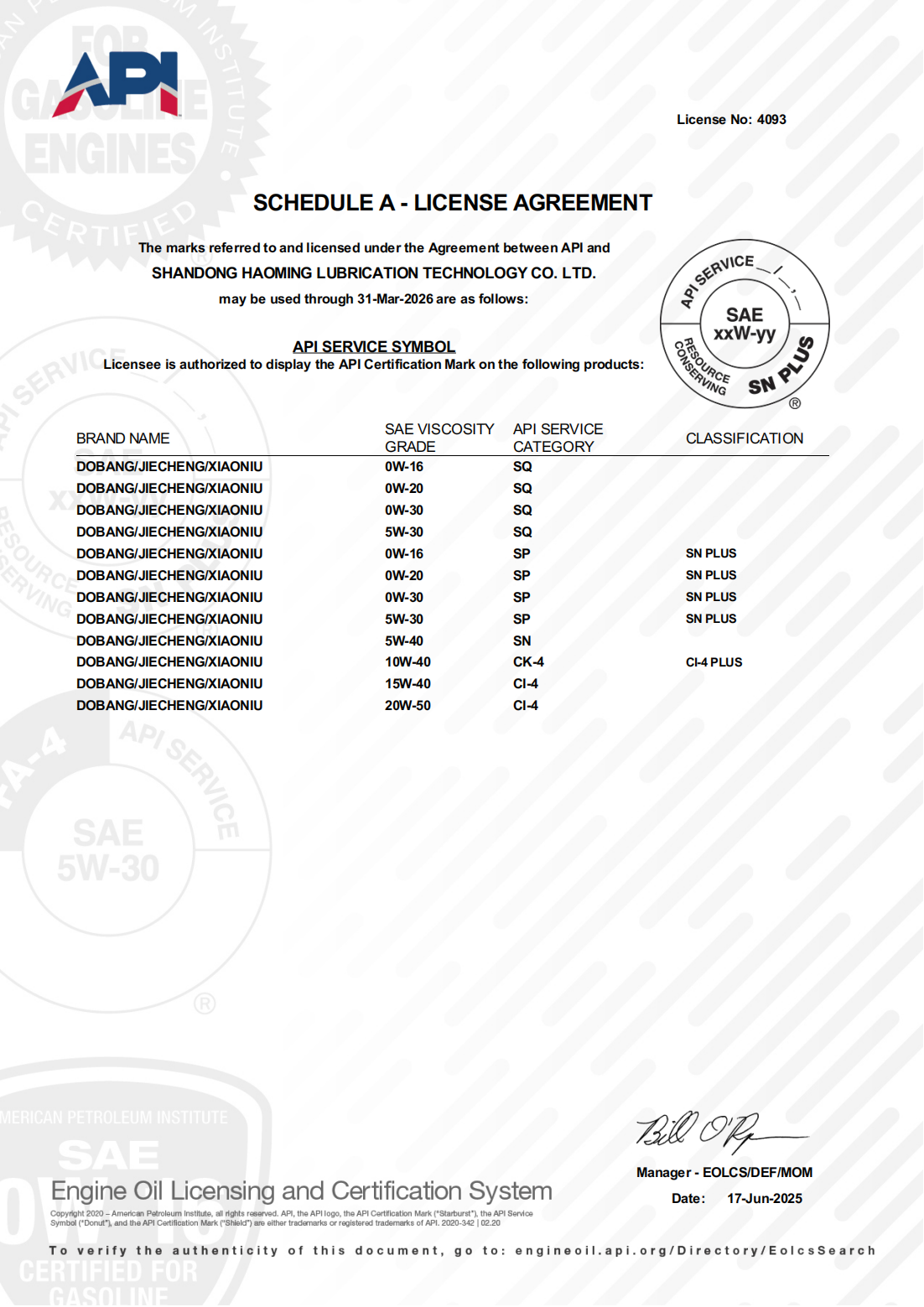
In certification, HAOMING has passed IATF 16949 (including product design), ISO 9001, ISO 14001, and ISO 45001 system certifications. It has also obtained API SQ/SP full-viscosity coverage approval from 0W-16 to 20W-50, as well as multiple ACEA certifications in Europe. In 2026, HAOMING also participated in drafting two group standards: “Technical Requirements for Special Lubricants for New Energy Vehicle Drive Motor Systems” and “Low-Ash Engine Oil for Hybrid Vehicles.” This means that whether customers want to produce high-end full synthetic engine oil, heavy-duty diesel engine oil, or new energy vehicle fluids, they can directly leverage HAOMING’s certification foundation to significantly shorten their time to market. A brand owner who has worked with HAOMING for years calculated: building their own plant and completing API and ACEA certification would take at least two years and millions of RMB in continuous investment. With HAOMING, from formula confirmation to first batch shipment, the fastest case took less than one month.
New Energy Track and Global Market: Positioning Early for the Next Journey
Traditional lubricant market growth is slowing, but demand for new energy vehicle fluids is rising. Hybrid-specific engine oils, electric drive reducer oils, insulating coolants, and thermal management system fluids—these categories have technical requirements different from traditional oils, and many contract manufacturers are still in the product reserve stage.
HAOMING began laying out its new energy full-vehicle fluid product line as early as 2022. It now has complete formulation and production capabilities from reducer oil to thermal management fluid, with more than 20 products across three major series: hybrid series, pure electric series, and battery thermal management fluids. The company can provide customers with a full-spectrum fluid solution compatible with both traditional and new energy vehicles, covering all scenarios of industry iteration.
Meanwhile, HAOMING’s export business is growing steadily. Products have entered more than a dozen countries including Thailand, Malaysia, Vietnam, Russia, Pakistan, Tanzania, Nigeria, and Iraq. With its own logistics fleet, domestic customers also benefit from timely delivery from the Dongying factory directly to regional warehouses nationwide, with an on-time delivery rate of over 98%.
Service Is Not a Slogan—It Is a Systematic Capability
HAOMING positions itself as a “service-oriented manufacturing enterprise.” These words are translated into a complete set of actions internally. OEM customers can receive: assistance with API/ACEA certification applications; shared formula upgrades and R&D results; use of CMA/CNAS laboratory reports for tenders; and full-process closed-loop support from formula development to filling and delivery.
Each year, HAOMING invests about 5% of its revenue in R&D. When the API standard upgraded from SP to GF-7, the company completed the switch and validation of all OEM formulas within three months, and customer products almost simultaneously obtained the latest classification. As the HAOMING team puts it: “Customers don’t need to maintain their own R&D team. HAOMING is their R&D department and quality department.”
From a small oil factory next to Shengli Oilfield to an industry OEM manufacturer serving more than a dozen countries, multiple leading auto parts chains, and dozens of brands, HAOMING has proven one thing over more than a decade: in an era of increasingly refined industrial division of labor, what is truly scarce is not production capacity, but the ability to give brand owners peace of mind. And at the core of that ability are just two things—solid hardware investment, and the cooperative mindset of “achieving customers first, then achieving ourselves.”